
Updated October 31, 2026. I will update this page when the October Florida metro numbers come out on November 16.
How much house can I afford with a $100K salary? People type that exact question into Google thousands of times a month. A lot of them make good money and still feel priced out. In Florida right now the honest answer is about $324,000. That assumes 20% down, the 7.32% average 30 year fixed rate from the week of October 22, and a house payment that stays inside 28% of your gross income.
$100,000 a year sounds like plenty. Then you look at the median prices.
How much house can I afford with a $100K salary?
Here is the math I used, step by step, so you can check it or swap in your own numbers.
$100,000 a year is $8,333 a month before taxes. The old lender guideline says your house payment should stay at or under 28% of that, and all your debts together at or under 36%. 28% of $8,333 is $2,333 a month.
That $2,333 has to cover four things. Principal, interest, property taxes and insurance.
For insurance I used $2,768 a year. That is the statewide average premium for Citizens personal policies after this year’s approved rate changes. Call it $231 a month. Private quotes can be higher or lower depending on your roof, your flood zone and the county.
For property taxes I used 1.2% of the price a year. That is a planning number, not a quote. Your county millage and the homestead exemption change it, and a new buyer pays on the full purchase price, not the capped value your neighbor has been paying on since 2015.
Run it all the way through and $2,333 a month gets you a home price of about $324,000.
- Down payment at 20%: about $64,700
- Loan: about $259,000
- Principal and interest at 7.32%: about $1,779 a month
- Property taxes: about $324 a month
- Insurance: about $231 a month
Want to run your own county? Our Florida home affordability calculator builds in real county property tax and insurance, and the mortgage payment calculator lets you test any rate and down payment.
Can you afford a house in Florida making $100K?
Yes. Just not the typical one in most of the state.
The statewide median for existing single family homes in September was $415,000. To buy that home with the same math, you need about $125,400 a year.
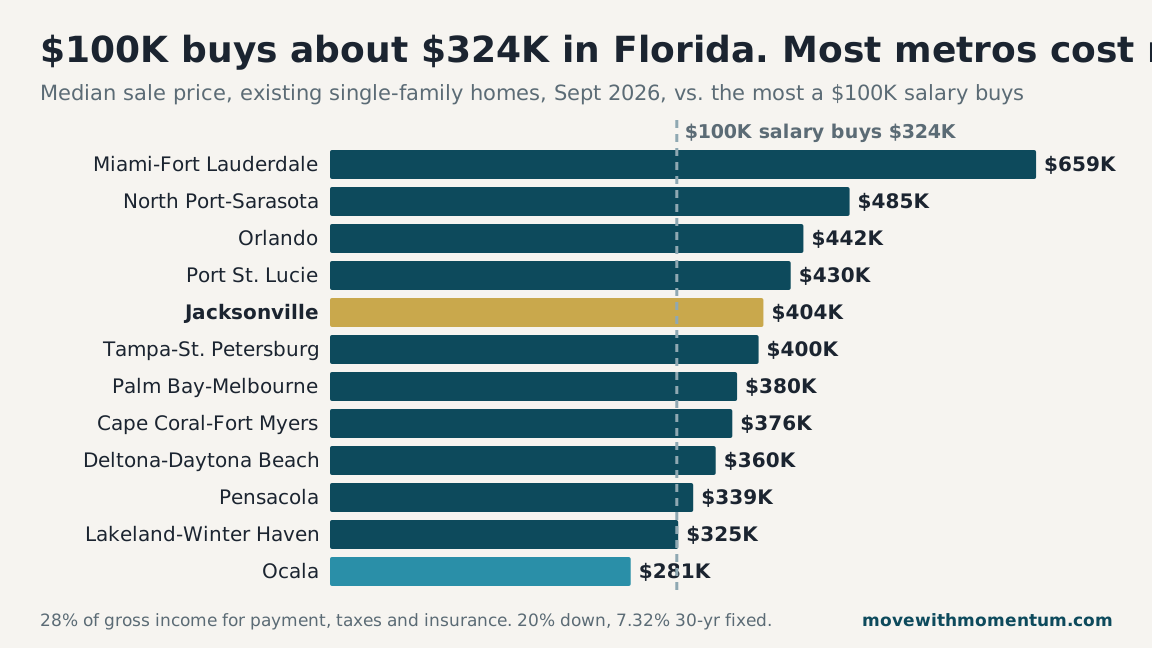
Here is how the big metros line up against $324,000.
Miami and Fort Lauderdale are at $659,000. North Port and Sarasota are at $485,000. Orlando is $441,860. Port St. Lucie is $430,000. Tampa is right at $400,000. Cape Coral and Fort Myers are $375,500. Daytona is $360,000. Pensacola is $338,986. Lakeland is $325,000, which misses by about a thousand dollars.
Out of 22 metro areas in the state, only three had a September median under $324,000. Ocala at $280,640, Homosassa Springs at $279,995 and Sebring at $259,888.
So a household making $100K can buy in Florida. It means a smaller house, an older house, a longer drive, or a market most people moving here have never heard of. If you want the lowest true monthly cost by county, we ranked them in our Florida most affordable counties study.
What salary do you need to buy a house in Jacksonville?
The Jacksonville metro median for single family homes was $404,495 in September. That covers Duval, St. Johns, Clay, Nassau and Baker counties. It was up 1.4% from a year ago while closed sales were down 7.0%.
With 20% down at 7.32%, that home runs about $2,858 a month with taxes and insurance. To keep that at 28% of income, you need about $122,500 a year. You also need about $80,900 in cash for the down payment, before closing costs.
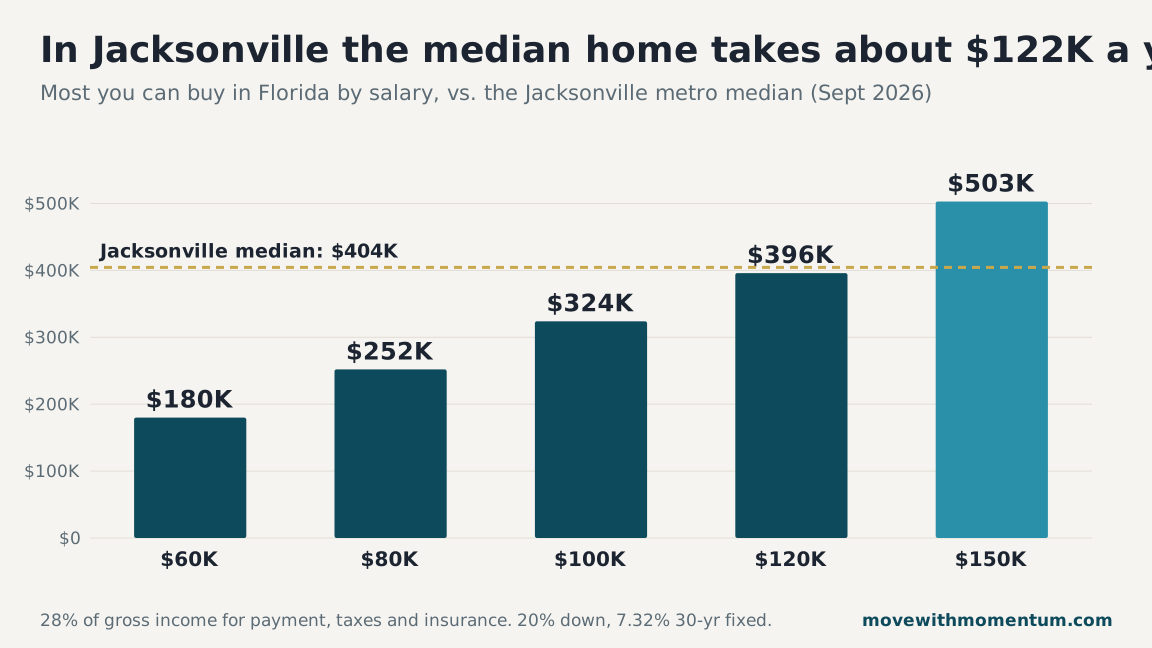
Here is the ladder at today’s rate.
- $60K salary: about $180,000
- $80K salary: about $252,000
- $100K salary: about $324,000
- $120K salary: about $396,000
- $150K salary: about $503,000
At $120K you are still about $9,000 short of the Jacksonville median. At $150K you clear it.
A metro median also hides a big spread between neighborhoods and counties. Our Jacksonville affordability tracker updates the payment and the income to qualify every week, and the Jacksonville market data page breaks it down further.
How much have mortgage rates changed what $100K can buy?
This is the part that hurts.
On February 26 the average 30 year fixed hit 5.98%, the low for the year. At that rate the same $100K salary bought about $363,000. Today it buys about $324,000. That is about $40,000 less house in eight months, with the same paycheck.
Go back to January 7, 2021, when the average was 2.65%. That same $100K bought about $498,000.
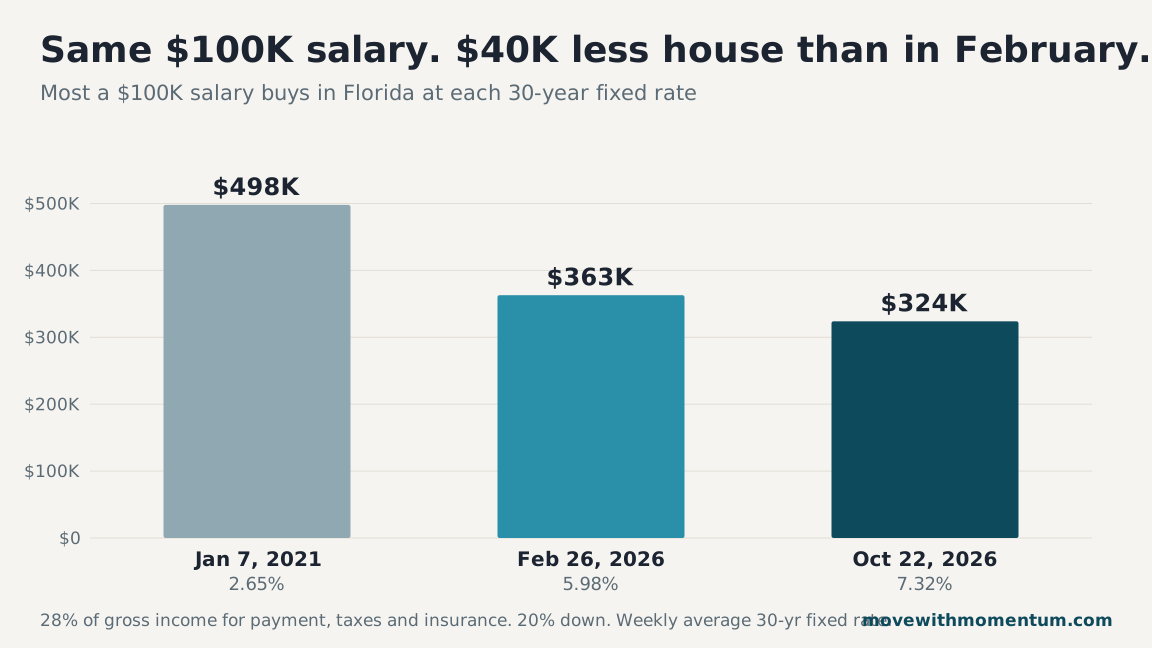
Every full point on the rate is real money. If rates dropped back to 6.32%, a full point lower than today, $100K would buy about $353,000. That still does not get you to the Jacksonville median.
Prices and rates are really one number. When rates went up, the seller did not lower the price to make up for it. The buyer just got less house. And it is a big reason contracts have been falling. I went through that in will Florida home prices drop?
What if I put less than 20% down?
If you put less than 20% down, two things happen. The loan is bigger, and you usually add mortgage insurance to the payment. Both eat into the same $2,333. So the price you can afford goes down, not up.
The flip side is you can get in with a lot less cash. If you are figuring out what you need to bring to closing, start with our guide on how much a down payment on a house really is, including the Florida help you may qualify for. If it is your first purchase here, the first time home buyer guide for Jacksonville walks through the whole process.
Will a lender approve me for more than this?
Probably. The 28% number is a guideline, not a law. Automated underwriting at Fannie Mae can approve total debt up to 50% of income.
Approved and comfortable are two different things. The lender is looking at whether you can make the payment. You have to live on what is left. In Florida, insurance and taxes can move after you close, and that can leave you with an escrow shortage and a higher payment. If you want to see how that works, here is our Florida escrow shortage calculator.
My advice is to know your 28% number before you ever talk to a lender. Then decide for yourself how far past it you are willing to go.
What to watch next
Three things will move this math over the next few months.
- Mortgage rates. The weekly average comes out every Thursday. I will update this page any week it moves by a quarter point or more.
- Florida’s October numbers on November 16. If contracts keep falling, prices are next, and the gap between incomes and medians starts to close from the price side.
- Insurance renewals. Citizens cut rates in most counties this year. If private carriers follow, that monthly number goes down and your budget goes up.
If you are trying to figure out what you can afford in a specific neighborhood, talk to a Momentum agent and we will run your real numbers.
Frequently asked questions
How much house can I afford with a $100K salary?
In Florida, about $324,000 as of late October 2026. That assumes 20% down, a 7.32% 30 year fixed rate, property taxes at 1.2% of the price, $2,768 a year for insurance, and a total house payment of 28% of gross income, or $2,333 a month.
What salary do I need to buy a house in Florida?
About $125,400 a year for the statewide single family median of $415,000 (September 2026), using the same assumptions.
What salary do I need to buy a house in Jacksonville?
About $122,500 a year for the Jacksonville metro single family median of $404,495 (September 2026), plus about $80,900 for a 20% down payment.
How much house can I afford on a $150K salary?
About $503,000 in Florida at a 7.32% rate with 20% down. On $120K it is about $396,000, and on $80K it is about $252,000.
How much did higher rates cut what I can afford?
At the 2026 low of 5.98% on February 26, a $100K salary bought about $363,000. At 7.32% it buys about $324,000, roughly $40,000 less. At 2.65% in January 2021 it bought about $498,000.
Is the 28% rule what lenders actually use?
It is a common guideline. Lenders look at your total debt too, and automated underwriting at Fannie Mae allows total debt up to 50% of income. Being approved for more does not mean the payment is comfortable.
Jon Brooks is the co-founder of Momentum Realty and a Florida housing market analyst. More of Jon Brooks' housing research.
Figures are estimates from the stated assumptions and are deemed reliable but not guaranteed. This is general information, not lending, tax or financial advice.