
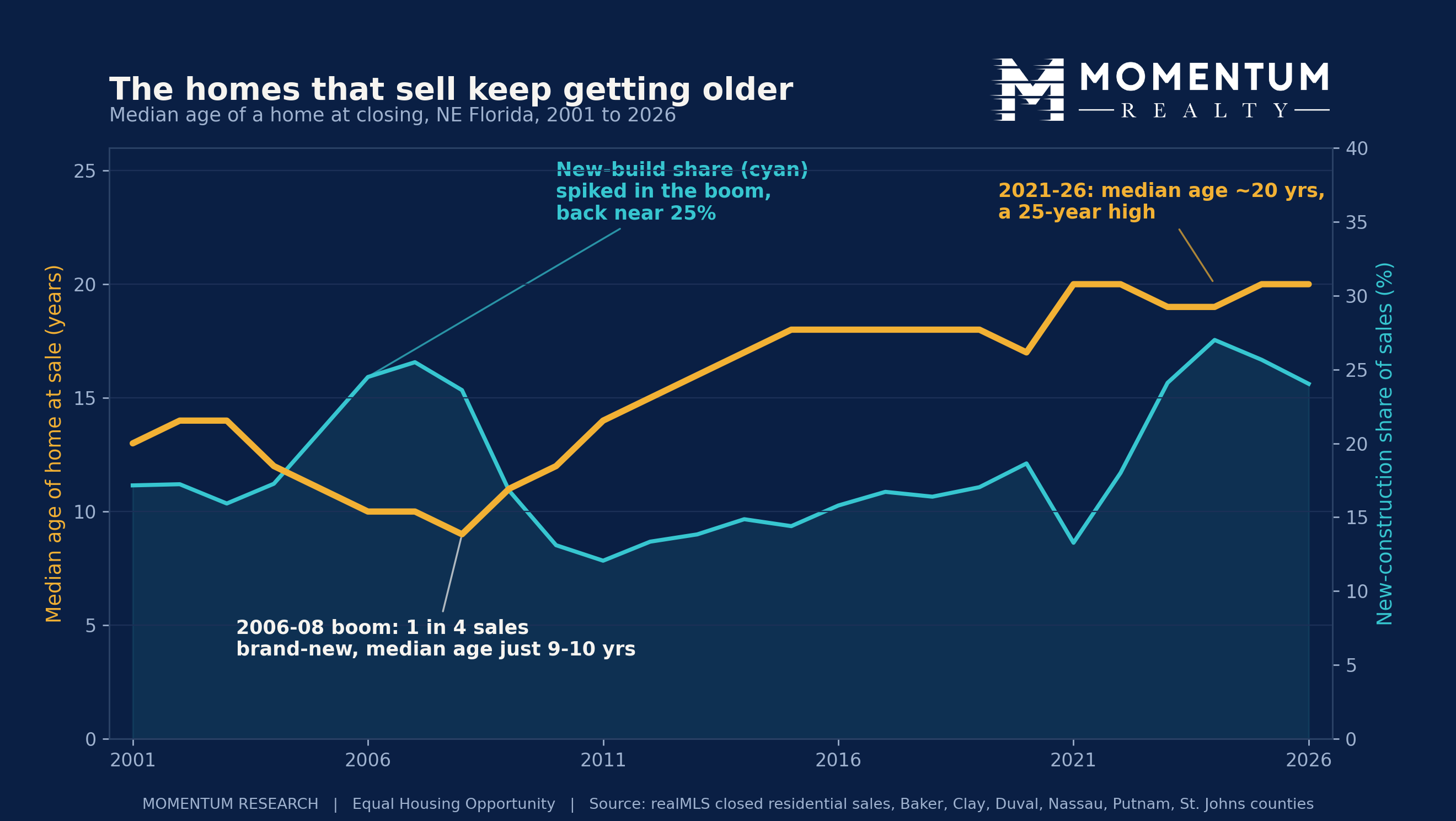
Here is a simple question with a surprising answer: how old is the typical home that changes hands in Northeast Florida? In 2026 the median home that sold was about 20 years old, meaning it was built around 2005 or 2006. That is a 25-year high, and it is roughly double the 9 to 10 years that was typical during the mid-2000s building boom.
We took every closed sale back to 2001, subtracted each home's year built from its sale year, and took the median age for each year. Measuring it the same way every year makes the long arc easy to read.
From 10 years old to 20
In 2001 the median home that sold was about 13 years old. Then it got younger. Through the 2004 to 2008 building boom the median age fell to just 9 to 10 years, because so much of what sold was brand-new. At the 2007 peak, better than one in four closings was new construction, and a new home is zero or one year old. All of that fresh supply pulled the typical age down.
When the boom ended, the pattern reversed and has run one direction ever since. By 2011 the median age was back to 14, by 2015 it was 18, and from 2021 through 2026 it has held around 20. The homes selling today are, on the whole, the oldest they have been in our 25-year record.
The boom built the stock we are now reselling
The reason is two forces working together. The first is what happened to new construction. Its share of sales collapsed from about 25 percent at the 2007 peak to about 12 percent in 2011 as builders stopped, and it stayed subdued for years. Fewer brand-new homes in the mix meant the median age had nowhere to go but up.
The second force is arithmetic. The enormous wave of homes built during the 2000s boom did not disappear. It aged in place. A house built in 2005 was 3 years old when it first sold in 2008 and is 20 years old today. Because that cohort is so large, it now dominates resale activity, and every year that passes adds a year to its age. New construction has recovered to about 24 to 27 percent of sales since 2023, but even that has not been enough to pull the median age back down, because the resale base it is competing against is so much older and deeper than it was.
Why it matters if you are buying or selling
For buyers, the takeaway is not that older is worse. It is that a 20-year-old home is now the norm here, not the exception, so the right lens is condition and systems rather than the model year. A well-kept 2005 home can be a better buy than a corner-cut newer one. For sellers of a 2000s-era home, you are no longer the underdog next to new construction. You are the median of the market, and the way to win is to show updates and maintenance against a builder's higher price and smaller lot. As we covered when Northeast Florida home sales stopped falling, the market is active again, and buyers are underwriting condition carefully. For the full picture, see our Jacksonville housing market data hub.
How agents can use this data
With a buyer weighing an older home against a new build: reframe age as a systems question. At the 20-year mark, roof, HVAC, and water heater are the line items that matter. Price those in and an older, larger, better-located home often wins on value even though it is not new.
With a buyer nervous about a home's age: put it in context. The median home selling in Northeast Florida is about 20 years old, so their 2004 house is squarely normal, not a compromise. Age alone tells you very little about a specific home's condition.
With a seller of a 2000s-era home: position against the new-build alternative. Most of what sells is now this vintage, so lead with what has been updated and maintained, and let the buyer weigh that against a builder's premium and smaller lot.
On social or with press: the chart carries it. One line: the typical home selling in Northeast Florida today was built around 2005, roughly 20 years old, double the 9 to 10 years that was normal in the mid-2000s boom.
Keep it about homes and the market, never about who lives where. Cite the source line below if you quote the numbers, and never present them as guaranteed.
People also ask
How old is the typical home that sells in Northeast Florida?
In 2026 the median home that closed in the realMLS footprint (Baker, Clay, Duval, Nassau, Putnam, and St. Johns counties) was about 20 years old at sale, up from about 9 to 10 years old during the mid-2000s building boom, per Momentum Research analysis of realMLS closings.
Why are the homes that sell getting older?
Two forces. In the 2006 to 2008 boom about a quarter of all sales were brand-new construction, which pulled the median age down. Since then homebuilding did not keep pace with demand, so the large stock built in the 2000s has aged in place and now makes up most resale activity, per realMLS closing records.
Should buyers worry about a home being 20 years old?
A 20-year-old home is now the market norm in Northeast Florida rather than an outlier, so age alone is not a red flag. It does mean checking the age and condition of big-ticket systems like the roof, HVAC, and water heater, per general home-buying guidance.
The takeaway
The age of the typical home that sells is a quiet gauge of how much building is happening. When it falls, builders are flooding the market with new homes, as they did in the mid-2000s. When it climbs, the existing stock is carrying the market. In Northeast Florida it has climbed from 9 to 10 years in the boom to about 20 today, a 25-year high, which tells you the homes built in the 2000s are now the heart of the resale market and that new supply, even after recovering, has not kept up with demand. For how buyers are paying for these homes, see the financing mix behind these sales. Data reflects closed sales in the realMLS footprint and is deemed reliable but not guaranteed. This is general information, not investment advice.
Momentum Research. Equal Housing Opportunity.
This article was compiled with the help of automated tools from realMLS closing records and may contain errors. Information is deemed reliable but not guaranteed. It is for general information only and is not financial, investment, legal, or tax advice. Verify all facts independently before relying on them. Source: Momentum Research analysis of realMLS closed residential sales, Baker, Clay, Duval, Nassau, Putnam, and St. Johns counties, median age of home at sale (sale year minus year built) and new-construction share, 2001 to 2026.