
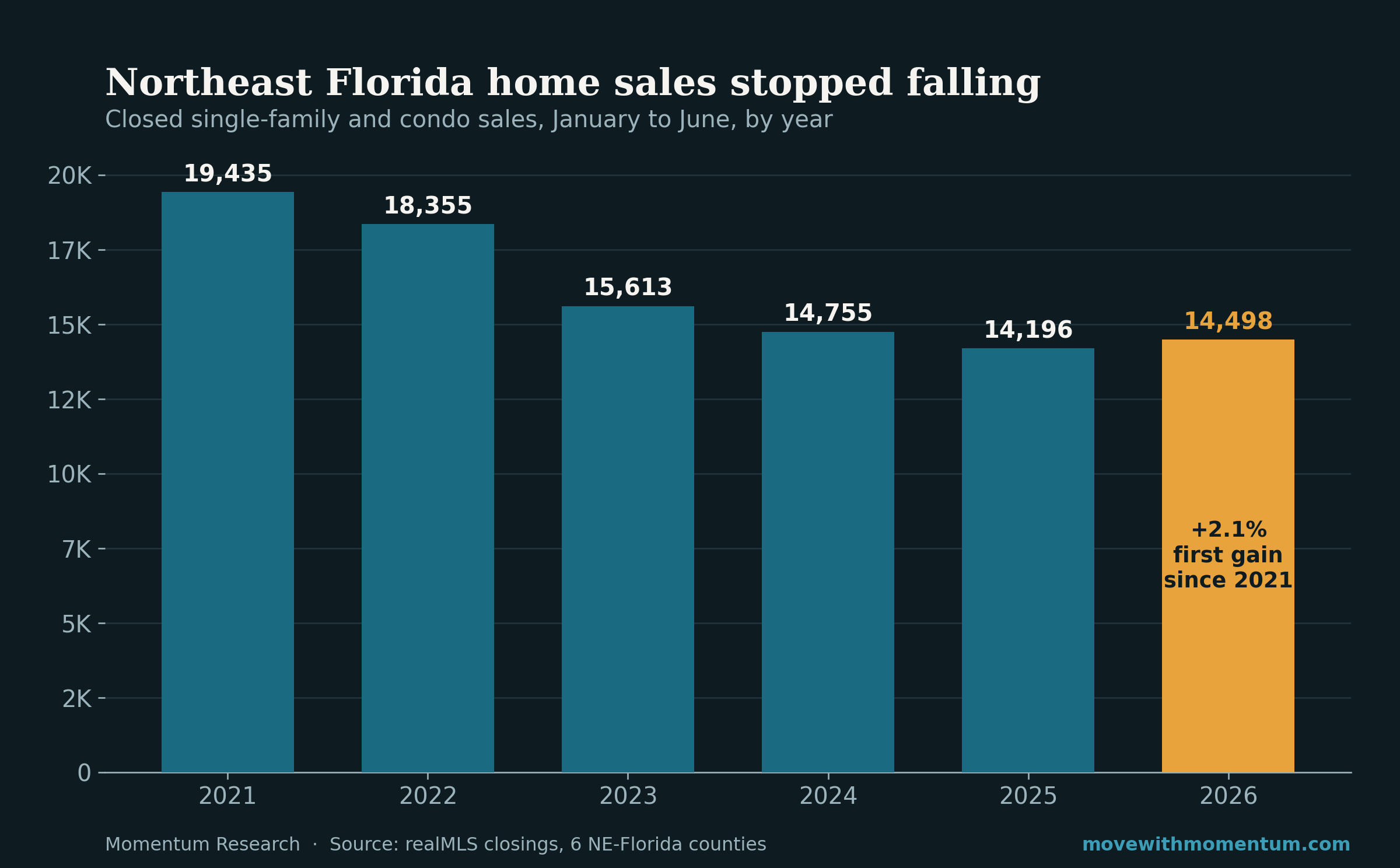
For four straight years, home sales in Northeast Florida did nothing but fall. In the first half of 2026 they finally stopped. Closed sales across the six county realMLS footprint rose about 2.1 percent through June, 14,498 closings against 14,196 in the first half of 2025. It is a small number, but it is the first year over year gain since the 2021 peak, and it happened with the 30 year mortgage rate sitting near an 11 month high.
We pulled every closed sale from realMLS back to 2001 and counted January through June by year, so the boom, the freeze, and this year all get measured the same way. Here is what the last six first halves look like, and why the floor matters more than the size of the bounce.
The numbers
First half closings ran 19,435 in 2021, then 18,355 in 2022, 15,613 in 2023, 14,755 in 2024, and 14,196 in 2025. That is a staircase down, and 2023 alone dropped almost 15 percent as rates roughly doubled and the pandemic buying wave ended. In 2026 the count came in at 14,498, up 2.1 percent. The decline did not just slow, it reversed.
Price barely moved while volume was finding its floor. The median closed price in the first half of 2026 was about 360,000 dollars, essentially flat against 350,000 in 2025 and still near the highest we have recorded. What changed is that homes are trading again, just slowly: the median sale took about 40 days, versus 16 to 19 days in the frantic 2021 and 2022 markets.
Why sales stopped falling
Two things pulled buyers off the sidelines. First, inventory rebuilt. Statewide, Florida carried roughly 7.5 months of supply and more than 118,000 listings in early 2026, a very different market from the bare shelves of 2021, and more choice brings more transactions. Second, builders got aggressive on the payment, using price cuts and mortgage rate buydowns to bring the effective new construction rate well below the headline number. New construction held about a quarter of first half closings, roughly 24.5 percent, and cash held another quarter, so the market is being carried by both incentive shoppers and buyers who do not need a loan at all.
None of that made homes cheap. It made them movable. As we covered in an earlier Momentum Research piece on the negotiating pendulum, most sellers are now taking less than their original ask, which is exactly how a market clears when prices are high and rates are higher.
What it means if you are buying or selling
For buyers, a market that is transacting with 40 day median times and rebuilt inventory is a market with room to negotiate. You are not competing with ten offers on day one, and builder incentives are real money on new construction. For sellers, the read is more encouraging than the last three years but not a green light to overprice: volume is stabilizing, yet homes still sit about 40 days and most close below the first list price. Pricing to the current comps, not to last spring's, is what gets you sold. Buyers weighing entry level options should also see how the sub 200,000 dollar home nearly vanished here, because it reshapes what a starter purchase even looks like now.
How agents can use this data
With a buyer who thinks they missed the window: sales are rising again, but so is inventory and so are days on market. That combination is leverage, not a bidding war. Frame 2026 as a year with choice and negotiating room, backed by the closing count.
With an anchored buyer waiting for a crash: volume just turned up while the median price held near a high. The floor is showing up in the data, not just in agent talk. If the plan is to time a bottom in price, the sales trend is not cooperating.
With a seller positioning a listing: more homes are selling than a year ago, but the median still takes about 40 days and most close under the original ask. Use that to set a realistic price and timeline up front instead of chasing the market down later.
On social or with press: the chart is the content. One line carries it: Northeast Florida home sales stopped falling for the first time since 2021.
Keep it about homes and the market, never about who lives where. Cite the source line below if you quote the numbers, and never present them as guaranteed.
People also ask
Are home sales going up or down in Northeast Florida in 2026?
Up, slightly. Closed sales across Duval, St. Johns, Clay, Nassau, Baker, and Putnam counties rose about 2.1 percent in the first half of 2026 versus the first half of 2025, 14,498 closings against 14,196, the first year over year gain since the 2021 peak, per Momentum Research analysis of realMLS closings.
Why did Northeast Florida home sales rise in 2026?
Inventory rebuilt and builders leaned on price cuts and mortgage rate buydowns, which pulled buyers back even with the 30 year fixed near 6.7 percent. After four straight annual declines from 19,435 first half closings in 2021, volume finally flattened and ticked up.
What is the median home price in Northeast Florida in 2026?
The median closed price in the first half of 2026 was about 360,000 dollars, essentially flat versus 2025 and near a 25 year high. Homes took a median of about 40 days to sell, per realMLS closing records.
The takeaway
A 2.1 percent gain is small, but the direction is the story. After a four year slide, first half sales in Northeast Florida rose in 2026 as inventory returned and builders bought down the payment, all while prices held near a high and rates stayed elevated. The market is not cheap and it is not fast, but it is moving again. For a fuller picture, see our Jacksonville housing market data hub. Data reflects closed sales in the realMLS footprint and is deemed reliable but not guaranteed. This is general information, not investment advice.
Momentum Research. Equal Housing Opportunity.
This article was compiled with the help of automated tools from realMLS closing records and may contain errors. Information is deemed reliable but not guaranteed. It is for general information only and is not financial, investment, legal, or tax advice. Verify all facts independently before relying on them. Source: Momentum Research analysis of realMLS closed sales, Duval, St. Johns, Clay, Nassau, Baker, and Putnam counties, January through June, 2021 to 2026.