
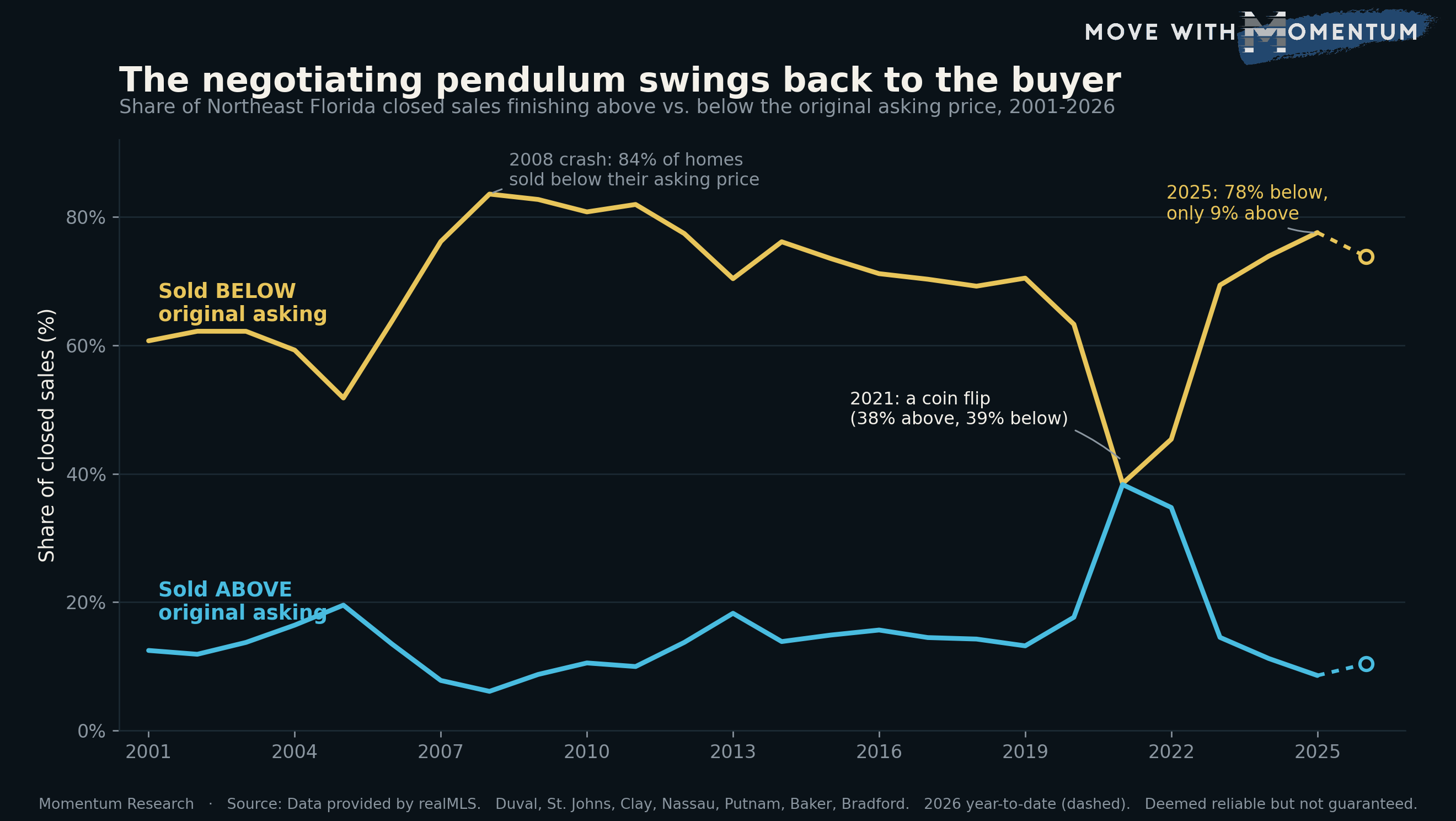
Home prices in Northeast Florida are sitting near a record. So here's a number that stopped me. In 2025, 77.5% of homes that sold closed for less than the seller first asked. That's the highest share of below-asking sales since 2011.
Both of those things are true at once, and most people only hear the first one. The median sale price held near its peak, around $350,000, just under the 2024 high. And yet more than three out of four sellers took less than their opening price. The market didn't crash. What changed is how much room sellers give back at the table.
From a coin flip to nine-to-one
Look at 2021. Buyers were bidding each other up, and it was close to even odds whether a home sold above or below its first asking price. It was 38.3% above and 38.5% below, as balanced as this market has been in 25 years of records.
Now it's lopsided. In 2025, only 8.6% of homes sold above the original ask, the lowest since 2008. Put the two together and you get about nine below-asking sales for every one above. The leverage swung back toward buyers, and it happened fast.
This is not 2008
Below-asking rates this high can sound alarming, because the last time the region saw them was the downturn. In 2008, 84% of homes sold under their asking price. We are not there, and the reason is simple. Prices held. In 2008 the below-asking share was high because values were falling. Today it's high because sellers keep listing above what buyers will pay, then negotiating down.
The typical 2025 seller took about $16,000 under their first asking price, a 4.5% haircut across all sales. That's not a fire sale. It's a market where the sticker price and the sale price have drifted apart.
It's affordability, not a value drop
Here's the part that gets missed. This gap didn't open because homes are suddenly worth less. It opened because buyers can no longer afford the prices sellers are asking. Mortgage rates more than doubled, and a monthly payment is what people actually shop for.
Run the math. A buyer who could comfortably afford a $500,000 home when rates were near 3% may only qualify for around $400,000 today, even if their income hasn't changed. Sellers priced off yesterday's market. Buyers were shopping off today's payment. That gap is what forced the negotiation, and it's why 77.5% of homes closed under their first ask. It wasn't a drop in demand or in value. Affordability became the constraint.
It shows up across the region, not in one pocket. Every one of the seven counties we track ran between 66% and 82% below-asking in 2025. St. Johns, the priciest of them, was the highest at 82%. That fits. The higher the price, the harder that payment math bites.
What it means for you
If you're buying: the asking price is a starting bid, not the price. More than three in four homes sold under list last year. Anchor your offer to what comparable homes actually closed at, not to the number on the sign, and don't assume you have to meet or beat the ask.
If you're selling: price your home for today's buyers, not yesterday's market. Homes that start with realistic pricing and are in good condition are still selling. The ones chasing 2021 pricing are usually the ones taking cuts later. If you want a real valuation with real comps instead of an algorithm, we'll put one together for you.
If you already own: none of this is a value problem. Prices are near a record. It's a negotiating-room story, not a price-drop story, and knowing the difference keeps you steady when the headlines don't.
These figures come from Momentum Research, computed from realMLS closed sales across Northeast Florida's seven counties, 2001 through mid-2026. Above and below are measured against each home's original list price, the first number the seller asked. Want the county-by-county cut or the full Momentum Market Pulse? It's free.
- Jon Brooks, Co-Founder, Momentum Realty / jon@movewithmomentum.com
This article summarizes Momentum Research findings and Jon Brooks's market commentary and includes his opinions. It is for general informational purposes only and is not financial, investment, legal, or tax advice. Metro-level statistics are never a price for any specific home. Data deemed reliable but not guaranteed. Consult a licensed professional about your situation.