
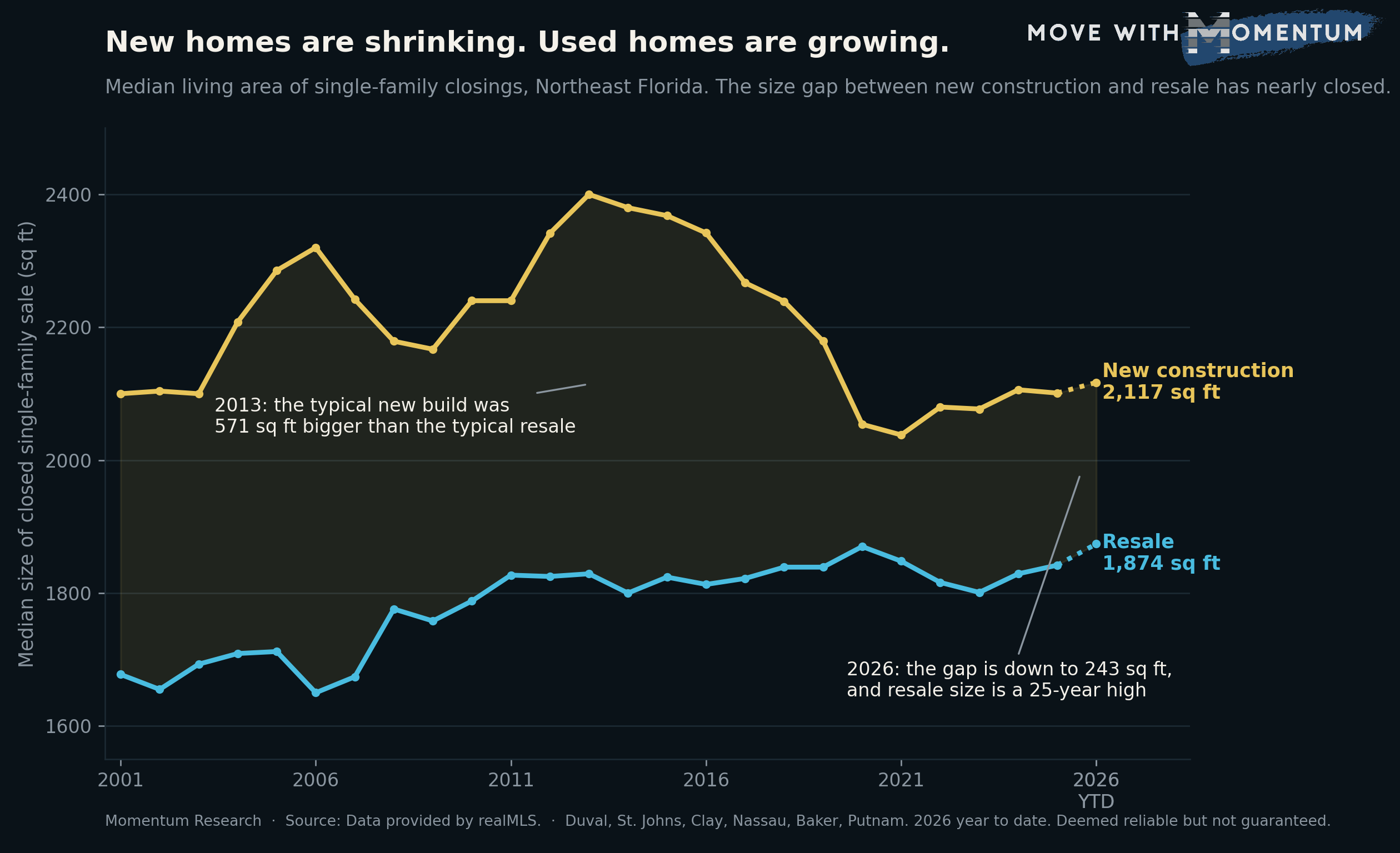
The new house is getting smaller and the used house is getting bigger, and the two are now closer in size than at any point in 25 years of Northeast Florida sales records. We pulled 456,343 single-family closings from realMLS back to 2001 and split them into new construction and resale. In 2013 the typical new build that sold was 2,400 square feet, a full 571 square feet bigger than the typical resale. So far in 2026 the typical new build is 2,117 square feet, the typical resale is 1,874, and the gap is down to 243.
Here is what a quarter century of closings shows, and why the shrinking new home is really an affordability story.
The numbers
Across Duval, St. Johns, Clay, Nassau, Baker, and Putnam counties, the median new construction single-family home that closed peaked at 2,400 square feet in 2013. It has since fallen 283 square feet, a decline of almost 12 percent, to 2,117 year to date in 2026. The low point was 2,038 in 2021, and the market has barely bounced off it.
Resale went the other way. The median resale closing was 1,677 square feet in 2001 and it is 1,874 so far in 2026, the largest in the 25 years we measured. The result is a market where the new home is only about 240 square feet, roughly one bedroom, bigger than the used one.
Why builders are shrinking the box
Builders responded to the affordability squeeze by engineering the product down: smaller floor plans, narrower lots, and more attainable spec homes aimed at the payment a buyer can actually qualify for at today's rates. The strategy is working on volume. New construction was 15 percent of single-family closings in 2013 and is 22 percent so far in 2026. As we covered in an earlier Momentum Research piece, the price per square foot premium for new construction has effectively vanished at the same time, which means builders are competing head on with the resale market on price and winning on financing incentives.
Why the used home is growing
The resale side is partly a stock story. The big homes built during the 2000s and 2010s expansions are steadily entering the resale pool, while owners of smaller entry level homes, many holding low pandemic era mortgage rates, have been the least likely to move. Fewer small homes listed plus an aging supply of larger ones pushes the median size of what actually sells upward.
What it means if you are buying or selling
For buyers browsing new construction communities, the trade is clearer than it used to be: new construction now means newer systems, builder incentives, and often a bought down interest rate, but not much more house. A resale purchase increasingly wins on square footage per dollar and on lot size. For sellers of larger resale homes, the data says your product is getting scarcer among new builds, which is a genuine marketing angle. For anyone comparing the two, run the numbers per square foot and per monthly payment, not just on sticker price.
How agents can use this data
With a buyer comparing new vs resale: new construction used to mean a much bigger house. Today the difference is about 240 square feet, roughly one bedroom. So the real comparison is financing and condition versus space and lot size. Run both options as a monthly payment, not a sticker price.
With a buyer who is anchored on new-only: you are no longer paying more per square foot for new, but you are not getting much more house either. If space is the priority, resale wins on square footage per dollar right now.
With a seller of a larger resale home: builders have mostly stopped building your product. The typical new build is 2,117 square feet, so an established home above 2,200 square feet is scarcer among new competition than it was five years ago. That is a marketing angle backed by closing data.
On social or with press: the chart is the content. One line carries it: builders shrank the box to save the payment.
Keep it about homes and the market. Cite the source line below if you quote the numbers, and never present them as guaranteed.
People also ask
Are new construction homes getting smaller in Florida?
In Northeast Florida, yes. The median new construction single-family closing fell from a 2,400 square foot peak in 2013 to 2,117 square feet year to date in 2026, a decline of almost 12 percent, per Momentum Research analysis of realMLS closings.
Is a new home bigger than a resale home in Northeast Florida?
Barely. The typical new build that closed so far in 2026 is 2,117 square feet versus 1,874 for the typical resale, a gap of 243 square feet. In 2013 that gap was 571 square feet.
What share of Northeast Florida home sales are new construction?
About 22 percent of single-family closings year to date in 2026, up from roughly 15 percent in 2013, per realMLS closing records for Duval, St. Johns, Clay, Nassau, Baker, and Putnam counties.
The takeaway
The shrinking new home is not a design trend, it is the affordability squeeze made visible in floor plans. Builders cut square footage to hit a payment, resale supply skews larger and older, and the size advantage that new construction held for two decades has mostly closed. Data reflects closed single-family sales in the realMLS footprint and is deemed reliable but not guaranteed. This is general information, not investment advice.
Momentum Research. Equal Housing Opportunity.
This article was compiled with the help of automated tools from realMLS closing records and may contain errors. Information is deemed reliable but not guaranteed. It is for general information only and is not financial, investment, legal, or tax advice. Verify all facts independently before relying on them. Source: Momentum Research analysis of 456,343 single-family closings, realMLS, 2001 through August 2026.