
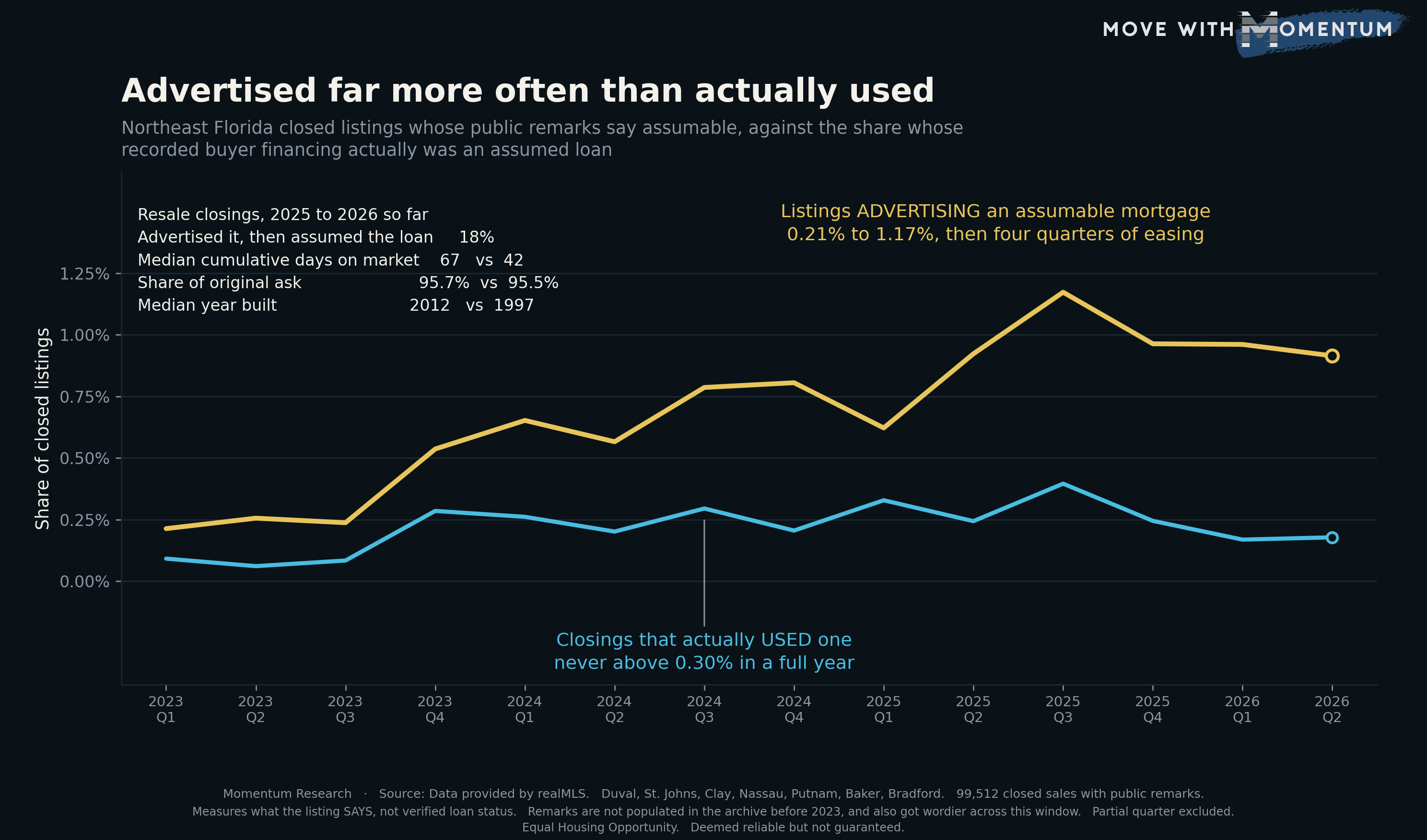
When mortgage rates doubled, one old idea came back: if the seller already has a loan at 3%, why not take it over instead of borrowing at today's rate? Northeast Florida sellers heard that argument and started putting it in their listings. The number of them doing it rose more than five times in three years.
Then we checked how often it worked. Of the 409 resale homes that closed in 2025 and 2026 with the word assumable in the listing, 17.8% actually closed with an assumed loan. The other four in five were sold to somebody who financed the ordinary way, or paid cash.
The advertised line rose five and a half times, then stopped
The series runs 2023 Q1 to 2026 Q2 and covers 99,512 closed sales across seven counties. It opens at 0.21% of closings, sits flat through 2023, then steps up: 0.54% in 2023 Q4, 0.79% by 2024 Q3, 0.92% in 2025 Q2 and a peak of 1.17% in 2025 Q3.
That peak is where the story turns. The four quarters since read 0.96%, 0.96%, 0.91% and, in the partial quarter we have excluded from the chart, 0.89%. The line has not collapsed, but it has stopped climbing. Whatever pulled the phrase into listings has finished pulling.
The line that matters is the one underneath
The cyan line counts the same closings, but asks a different question: was the recorded buyer financing an assumed loan? That line never gets above 0.40% in any quarter, and by full year it reads 0.119% in 2023, 0.239% in 2024, 0.301% in 2025 and 0.184% in 2026 so far.
Assumed financing is close to a new category in this market. It rounds to zero in every year from 2001 to 2016 in our archive, shows up at 0.007% in 2017, and was still only 0.025% in 2022. It is a product of the rate era, not a standing feature of Florida housing.
Advertising it works, and still fails four times in five
17.8% looks like failure until you put it against the base rate. Across all Northeast Florida closings with a recorded financing type, assumed loans were 0.30% in 2025. A listing that advertises an assumable mortgage is therefore about sixty times more likely than an average listing to close with one.
Both things are true at once. The signal is real, and the outcome is still the ordinary one four times out of five. That is what a feature with a narrow eligibility gate looks like from the outside.
Longer on the market, no discount at the end
Restricting to resale closings from 2025 onward, homes whose listing advertised an assumable mortgage took a median 67 cumulative days on market against 42 for other resale homes, about 60% longer. Yet they captured 95.7% of original asking price against 95.5%, which is the same number for practical purposes. Median close price was $378,000 against $349,000.
Slower to sell, no worse on price. That pattern fits a shrunken buyer pool rather than a weak product: fewer buyers can clear the qualification and cash-to-close hurdles, so the house waits longer, but the buyer who can clear them is not asking for a discount on top.
The stock is fifteen years newer, and that is the mechanism
Assumable-advertised homes had a median year built of 2012, against 1997 for other resale homes. That gap is not a coincidence, it is the explanation. The loans worth assuming were written in 2020 and 2021 at rates near 3%, and they sit on the homes people bought in 2020 and 2021.
New construction is almost entirely absent: 0.2% of assumable-advertised closings, against 24.3% of everything else. A loan cannot be taken over on a house that has not been financed yet. Anyone comparing this against our work on standing builder inventory is looking at the opposite end of the same market.
Where it happens, and where it does not
By county, the share of closings advertising an assumable mortgage runs Clay 1.19%, Nassau 0.86%, Duval 0.65%, St. Johns 0.57%, Baker 0.36%, Putnam 0.16% and Bradford 0.13%.
That ordering tracks loan type, not anything about who lives where. VA and FHA loans are the assumable ones, and the counties at the top of the list are the ones carrying more of them. Our earlier look at how Northeast Florida pays for homes found VA financing at a 25-year high of 17.0% of closings, which is the supply side of this same story.
What this does not prove
This measures what the listing says, not verified loan status. A home carrying a perfectly assumable VA loan whose agent never wrote the word lands in the comparison group, so that group is mixed.
The word is also not the meaning. Our match is the word assumable, and at least one match in the archive is a transferable roof warranty rather than a mortgage. Outright negations are almost absent, appearing twice in the whole archive, so the error runs slightly upward and is small.
Listing descriptions also got wordier over this window, and that has to be said rather than ignored. Median remarks length rose from 101 words to 139, and a neutral control word, kitchen, rose from 59.4% of listings to 69.9%, about 1.18 times. The assumable line moved about 5.5 times. The finding survives the drift comfortably, but part of the raw rise is drift, and the true move is smaller than the gold line alone suggests.
How agents can use this data
Four ways to put this to work, all of them about the home and the financing rather than about any buyer or seller:
1. Qualify the claim before you market it. A listing that says assumable is making a promise that fails four times in five. Before it goes in the remarks, get the loan type, the current balance, the rate, the servicer's assumption process and the expected timeline in writing. If the gap between the balance and the asking price is large, say so up front rather than discovering it in week nine.
2. Price the wait, not the discount. The measured pattern is 67 days against 42, at the same share of original ask. Set the seller's expectation on time rather than on price, and check that against a same-quarter comparison rather than against last year.
3. Use the county figures as a search filter, not as a description of an area. Clay at 1.19% and Nassau at 0.86% carry these listings at roughly twice the rate of St. Johns. That is useful for deciding where to look for one, and it is a statement about loan types in the housing stock, nothing more.
4. Check the year built first. The median assumable-advertised home was built in 2012. A 1985 house advertising an assumable mortgage is worth a second look before you build a strategy on it.
Whenever you use any of these figures with a client, cite the source and the date: Momentum Research analysis of realMLS closed sales, seven Northeast Florida counties, 2023 Q1 through 2026 Q2, pulled 26 August 2026. Numbers move, and a figure without a date is a figure without a shelf life.
People also ask
What is an assumable mortgage, and which loans qualify?
An assumable mortgage is an existing home loan that a qualified buyer takes over from the seller at the seller's original interest rate and remaining balance, rather than taking out a new loan at today's rate. In practice the assumable loans in this market are government backed: VA and FHA. Conventional loans generally are not assumable. The buyer still has to qualify with the servicer, and has to cover the difference between the loan balance and the purchase price, which is the part that stops most assumptions.
How common are assumable mortgages in Northeast Florida?
Rare, and rarer than the marketing suggests. In the 2026 second quarter, 0.91% of closed listings in the seven-county Northeast Florida market carried the word assumable in the public remarks. Loans that actually were assumed came to 0.30% of closings with a recorded financing type in 2025 and 0.18% in 2026 so far. Before 2017 the figure rounds to zero in every year of our archive.
Do homes advertised with an assumable mortgage sell faster?
No. In Northeast Florida resale closings from 2025 onward, homes whose listing advertised an assumable mortgage took a median 67 cumulative days on market against 42 days for other resale homes, roughly 60% longer. They did capture about the same share of original asking price, 95.7% against 95.5%. This comparison holds nothing else constant.
The takeaway
The assumable mortgage became a marketing line faster than it became a transaction. Sellers adopted the phrase five and a half times over, buyers used the thing about a fifth as often as it was offered, and the advertised line has now been flat or falling for four straight quarters. It is a real feature with a narrow gate, and it should be sold as one.
Method and limits
Source: realMLS, Duval, St. Johns, Clay, Nassau, Putnam, Baker and Bradford counties, closed residential sales. Records are deduplicated on ListingId plus CloseDate. 99,512 closings carry public remarks across 2023 Q1 to 2026 Q2. A quarter needs 4,500 closings to be plotted, which excludes the in-progress 2026 Q3 and no complete quarter. The advertised series matches the word assumable in the public remarks; the used series reads the recorded BuyerFinancing field for an assumed loan. The outcome comparison is restricted to resale closings from 1 January 2025 onward, because new construction is structurally ineligible for a loan assumption and leaving it in the comparison group would compare against a population that cannot do the thing being measured.
Four limits carried from above: this counts what listings say rather than verified loan status; the regex matches a word and not its meaning; listing descriptions got measurably wordier across the window, which accounts for some of the rise; and the outcome comparison holds nothing constant, so the two groups differ on age, price and construction type. The record begins in 2023 because public remarks are not populated before then in this archive, which is a gap in the field rather than a reading of zero.