
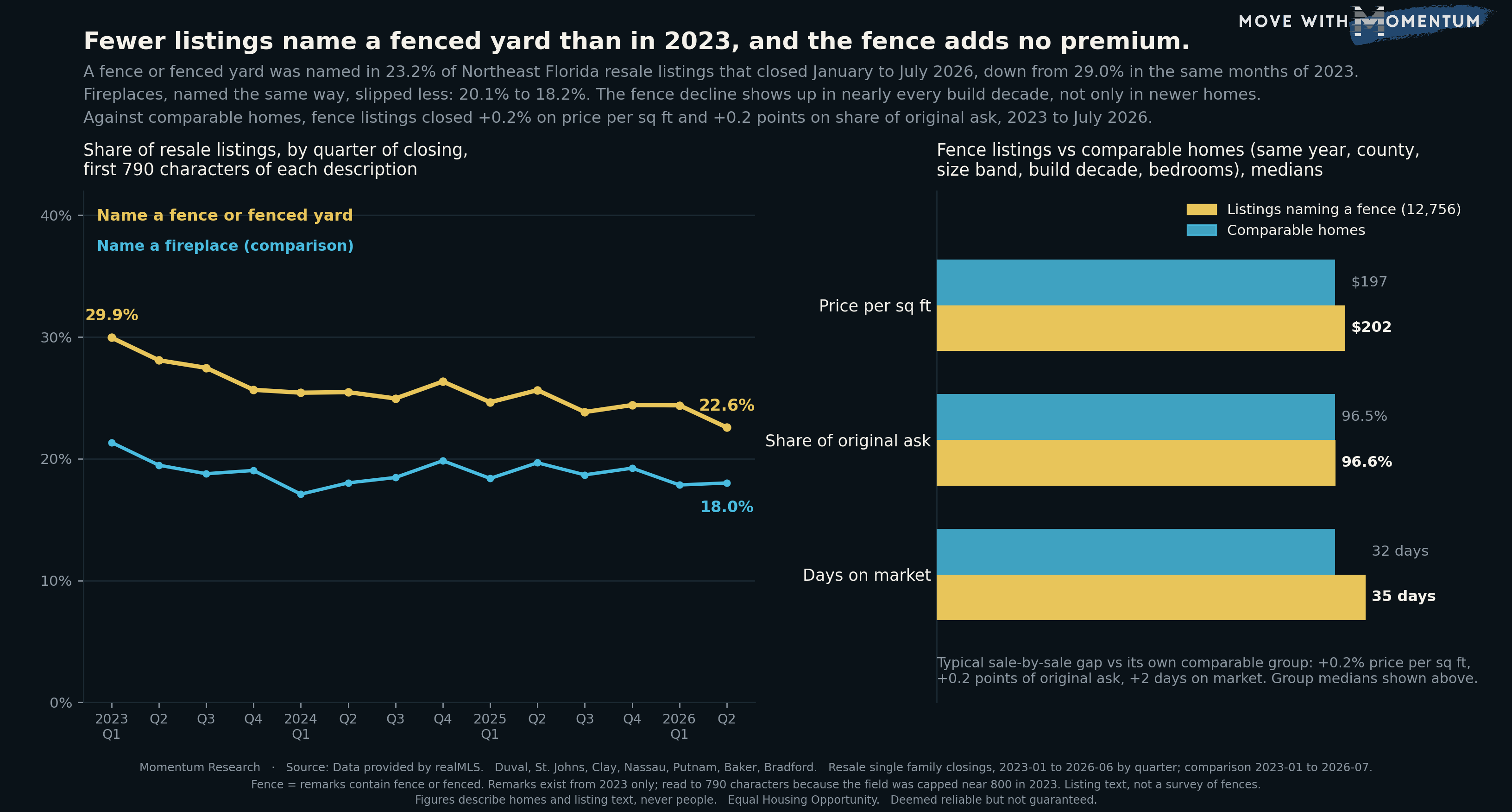
Fewer Northeast Florida resale listings name a fence than three years ago. In January to July 2026, 23.2% of resale single family homes that closed had a fence or fenced yard named in the listing description, down from 29.0% in the same months of 2023. Fireplaces, named the same way in the same text, slipped by much less (20.1% to 18.2%).
The drop is not a story about price. Against comparable homes, the listings that name a fence sold at about the same price per square foot and share of the asking price, and about two days slower, so the fence in the remarks never showed up as a premium. What changed is how, and how often, the yard is described.
How the fenced yard listings were counted
There is no fence field in the archive, so the study reads the public remarks written for each listing. A listing counts when its remarks contain fence or fenced, which picks up fenced yard, fenced backyard, fully fenced, privacy fence and similar wording. The comparison line counts listings that name a fireplace, another physical feature that agents list the same way. This is a measure of listing text, not a survey of fences.
Remarks are only in the archive from 2023, so the series starts there. In 2023 the remarks pile up at 799 characters and from 2024 at 999, which points to a field limit that was widened. A phrase near the end of a long 2026 description would have been cut off in 2023, so every listing in every year is read only in its first 790 characters. Annual shares use the same January to July window each year, because the archive runs through August 13, 2026 and July is the last complete month.
One in four listings now names a fence
On the fixed January to July window the share went from 29.0% (2,906 of 10,032 sales) in 2023 to 25.3% (2,444) in 2024, 25.0% (2,382) in 2025 and 23.2% (2,301 of 9,901) in 2026. By quarter of closing it slid from 29.9% in the first quarter of 2023 to 22.6% in the second quarter of 2026. Full calendar years agree (27.9%, 25.5% and 24.7% for 2023 to 2025), and so do the August to December months (26.0%, 25.9% and 24.2%), so the partial year is not creating the trend.
The decline appears in every build decade. Homes built before 1960 went from 28.1% to 23.9%, the 1980s from 31.5% to 25.5%, the 1990s from 27.3% to 21.5%, the 2000s from 28.4% to 21.1% and the 2010s from 30.5% to 22.1%. Homes from 2020 on went from 24.5% to 21.8%. It also appears in every large county: Duval from 29.6% to 25.4%, Clay from 35.3% to 27.6%, Nassau from 31.5% to 22.4% and St. Johns from 22.9% to 16.5%.
The wording changed more than the yards
The change is concentrated in one older phrase. Listings that say fenced in (as in the fenced in backyard) went from 8.8% of resale listings in 2023 to 6.1%, 5.1% and 2.5% in 2026. Listings that say fully fenced went the other way, from 8.6% to 7.4%, 8.8% and 10.5%. Everything else that names a fence, such as a fenced yard, a privacy fence or a fence around acreage, slipped from 13.1% to 10.6%.
So part of the decline is vocabulary, and part is that fewer descriptions spend words on a fence at all. The comparison line shows this is not simply shorter descriptions: median length inside the 790 character window held near 114 words in 2023 and 118 in 2026. For more on how description wording has shifted, see our study of stock words in listing descriptions.
Fence listings and comparable homes sold alike
On raw medians the fence listings look cheaper: $345,000 against $395,000 for other resale homes, at $201 against $210 per square foot. They are also smaller (1,701 against 1,890 square feet), which is why the raw gap means little.
The like-for-like test compares each fence listing with the median of resale homes that did not name a fence in the same close year, county, 400 square foot size band, build decade and bedroom count. Across 12,756 fence listings with at least ten comparable homes, the typical one closed 0.2% higher on price per square foot ($202 against $197 for the group medians), 0.2 points higher on the share of original asking price (96.6% against 96.5%), and two days slower (35 days against 32.5). None of those gaps is large enough to read as a premium or a penalty.
Rival explanations we tested
- A shift toward newer homes. Homes built 2020 or later grew from 7.4% to 13.7% of the resale mix, and they name fences less often. Applying 2026's within-group shares to the 2023 mix of description length, county, price band, bedroom count and build decade gives 24.9% rather than 23.2%, so mix explains about 1.7 of the 5.7 point decline. Most of it is inside comparable groups.
- Price band and bedroom count. The share fell from 31.5% to 28.4% under $300,000, 34.6% to 28.3% from $300,000 to $500,000, 22.2% to 16.9% from $500,000 to $750,000 and 11.0% to 7.3% above $750,000. By bedroom count it fell from 26.0% to 19.1% for two bedrooms, 32.1% to 26.5% for three, 26.9% to 22.5% for four and 20.9% to 12.9% for five or more.
- Description length. Listings of 90 to 120 words fell from 36.5% to 23.0%, those over 120 words from 29.0% to 25.2% and very short ones under 90 words from 23.0% to 18.5%, so the decline is not confined to one length.
- One year hiding another. The like-for-like price per square foot gap was +0.3% in 2023, +0.8% in 2024, 0.0% in 2025 and -1.0% in 2026. It drifts, but never reaches a meaningful size either way.
- County mix. The gap was +2.8% in Duval (8,097 sales), -3.9% in St. Johns (2,105), -1.5% in Clay (1,937) and -2.8% in Nassau (547). Mixed in sign, and the St. Johns and Duval figures partly reflect lot sizes and neighborhoods the comparison cannot see.
- Stronger wording. Listings that say fully fenced came in 0.9% higher on price per square foot, 0.6 points higher on share of original ask and two days faster (4,355 sales); the 420 listings naming a privacy fence came in 5.2% higher, a small group worth watching but not a settled premium.
What this cannot capture: remarks do not record whether a fence is new or worn, how much of the lot it encloses, or what it cost. A fence in good repair could matter to a particular buyer. The finding is that the phrase, as it has been used in listings here since 2023, does not show up as a price difference in the closed data.
How agents can use this data
- Describe the fence, not just its existence. About three in four resale listings do not name a fence at all, and the phrase fenced in is fading. Stating the material, the height, whether it encloses the whole back lot, and whether gates are included gives buyers something concrete about the home.
- Do not price the label. Fence listings closed at about the same price per square foot as comparable homes in the same county, size band, build decade and bedroom count. A seller who expects a fence to add to the price can be shown the like-for-like figures above and matched sales, the same approach used in our look at the pool premium.
- Verify the fence on site and on the survey. Listing text is a marketing summary. Confirming condition, fence lines and any HOA or deed rules on fences before a price discussion keeps a comparative market analysis honest, as in our study of no HOA as a selling point.
- Watch the text window. If you track listing language yourself, read every year to the same character length. The 2023 remarks field held about 800 characters and later ones about 1,000, a trap also covered in our home office listings study.
Whichever way you use the numbers, cite the source: Momentum Research analysis of data provided by realMLS, resale single family closings January 2023 through July 2026, deemed reliable but not guaranteed.
What this measurement does not do
It does not forecast, value any home or judge any listing. It measures listing text, prices and time on market for homes, never the people buying or selling them, and it should be read alongside a current comparable-sales analysis rather than in place of one.
People also ask
Does a fenced yard add value to a house in Jacksonville?
Not as a line in the listing. From January 2023 to July 2026, 12,756 Northeast Florida resale homes whose description named a fence or fenced yard closed a median 0.2% higher on price per square foot than comparable homes in the same year, county, size band, build decade and bedroom count, 0.2 points higher on the share of original asking price, and about two days slower on the market. Those gaps are too small to read as a premium or a penalty.
How many homes for sale in Northeast Florida mention a fenced yard?
About one in four resale listings now. A fence or fenced yard was named in 23.2% of resale single family listings that closed January to July 2026 in the seven counties realMLS covers, down from 29.0% in the same months of 2023, 25.3% in 2024 and 25.0% in 2025. By quarter the share went from 29.9% in early 2023 to 22.6% in the second quarter of 2026.
Does a listing that says fully fenced mean the whole lot is fenced?
Not necessarily. The phrase is listing text, and the closed data holds no survey of fence lines. The wording is changing, though: listings saying fully fenced rose from 8.6% to 10.5% of resale listings between 2023 and 2026, while the older phrase fenced in fell from 8.8% to 2.5%. A buyer who needs a fully enclosed yard should confirm the fence, gates and condition in person and on the survey.
Method and limits
Source: data provided by realMLS. Closed resale single family sales (NewConstructionYN false, PropertySubType Single Family Residence) in the authoritative counties of Duval, St. Johns, Clay, Nassau, Putnam, Baker and Bradford, with listing remarks present. Records are deduplicated on listing id plus close date; sales under $10,000, under 500 square feet, or with a close price below half or above one and a half times the original list price are dropped.
Listing remarks (PublicRemarks) exist in the archive from 2023 only, and each description is read only to its first 790 characters in every year, because the 2023 field was capped near 800 characters and later years near 1,000. Annual shares use January through July of every year; the archive ends on August 13, 2026, so July is the last complete month. The quarterly series runs from 2023 Q1 to 2026 Q2.
The pooled comparison covers January 2023 through July 2026 (57,766 sales).
A fence listing is one whose remarks contain the word fence or fenced. Fully fenced, fenced in and privacy fence are sub-phrases of the same text search. The comparison counts listings whose remarks contain fireplace. Comparable homes are resale sales without fence wording in the same close year, county, 400 square foot living-area band, build decade and bedroom count (five or more grouped); a fence listing is compared only when its cell holds at least ten comparable sales. Reported gaps are the median across fence listings of each sale's difference from its cell median.
Fence condition, lot size, appraisal outcomes and buyer intentions are not observed. Cause is not identified.
Related reading on the same archive: home office listings, listing description words, pool homes and the price premium and the ongoing Jacksonville housing market tracker.
All figures on this page are per Momentum Research analysis of data provided by realMLS and are deemed reliable but not guaranteed. Equal Housing Opportunity.