
Bedrooms used to be the thing you paid up for in Northeast Florida. Now they are close to free by the foot.
We pulled every residential closed sale in the realMLS footprint back to 2001, 601,146 of them after removing duplicate listing and close date pairs, and compared one number: the median close price per square foot of four bedroom homes against the median for three bedroom homes. For the first two decades of the record the four bedroom carried a clear per foot premium. That premium is now gone, and it has been gone for eight straight years.
The premium peaked in 2011 and closed in 2019
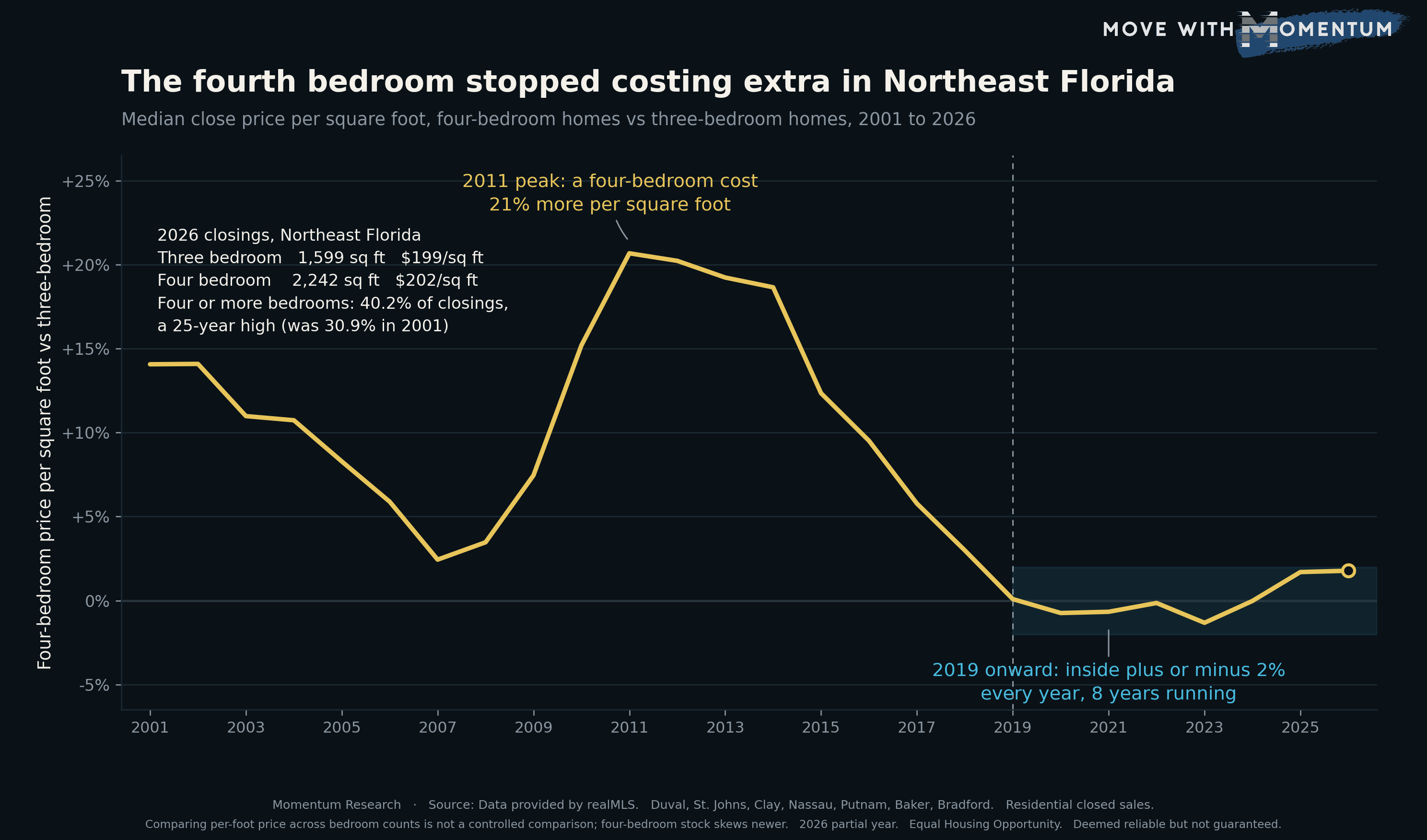
In 2001 a four bedroom home closed at about $80 per square foot against roughly $70 for a three bedroom, a premium of 14.1%. The gap widened through the downturn and reached 20.7% in 2011, the largest reading in the record. Then it fell, and it kept falling: 12.3% in 2015, 5.8% in 2017, 3.0% in 2018, and 0.1% in 2019.
Since 2019 the reading has stayed inside plus or minus two percentage points every single year: minus 0.7% in 2020 and 2021, minus 0.1% in 2022, minus 1.3% in 2023, flat in 2024, plus 1.7% in 2025 and plus 1.8% in a partial 2026. Eight consecutive years inside that band is the longest flat stretch in the series by a wide margin. In dollar terms the two now sit at $202 and $199 per square foot.
Meanwhile the four bedroom share hit a 25 year high
This is not a story about four bedroom homes falling out of favor. The opposite happened. Homes with four or more bedrooms were 30.9% of closings in 2001 and 40.2% in a partial 2026, the highest share in the record. Three bedroom homes went the other way, from 55.4% of closings to 46.5%.
So the market bought more bedrooms and stopped paying a per foot premium for them at the same time. Those two facts are more interesting together than either is alone.
The extra bedroom did not come with much extra house
The four bedroom home in this market has not been getting bigger. Its median living area peaked at 2,317 square feet in 2013 and measured 2,242 in 2026, about 75 square feet smaller. The three bedroom went the other way, from 1,529 square feet in 2001 to 1,599 in 2026.
Put the 2026 medians side by side and the arithmetic is plain. A three bedroom closed at $315,000 for 1,599 square feet. A four bedroom closed at $442,500 for 2,242 square feet. The $127,500 difference is almost entirely 643 additional square feet priced at the going rate, not a surcharge for the room count. Fifteen years ago a meaningful slice of that difference would have been the premium itself. For the underlying per foot trend across the whole market, see our analysis of price per square foot in Northeast Florida.
What this does not prove
Comparing price per square foot across bedroom counts is not a controlled comparison, and it would be wrong to read it as the isolated value of one room. Four bedroom stock skews newer, more suburban and more likely to be new construction than three bedroom stock, so location and vintage are mixed into both lines.
The 2010 through 2014 widening is the clearest example of that mixing. The premium did not grow because rooms got more valuable in the downturn. The three bedroom side of the comparison carried a heavier share of low priced distressed sales in those years, which pushed the three bedroom median down and the measured gap up. Treat the peak as a composition effect and the decline after 2015 as the durable movement.
How agents can use this data
Four concrete uses, all of them about homes and pricing rather than about people.
The buyer comparing a three bedroom to a four bedroom. The honest framing today is square footage, not bedroom count. Show both medians and the per foot figures side by side and the conversation stops being about whether the fourth bedroom is worth a premium and starts being about how much house the budget buys. In 2011 that conversation would have gone differently.
The seller of a four bedroom deciding how to price. A pricing model built on the assumption that bedroom count earns a per foot premium has been wrong in this market since 2019. Price the square footage and the condition. If a comp set is producing a four bedroom premium above a couple of percent per foot, the difference is likely coming from age, location or finish, and it is worth finding out which before it turns into a price cut later. Our piece on what overpricing actually costs covers what happens when it does.
The seller of a three bedroom. The per foot ceiling on a three bedroom is now essentially the same as the four bedroom ceiling. That is a stronger position than most three bedroom sellers assume, and it is a specific, checkable number to bring to a listing appointment rather than a general reassurance.
The social or press one liner. "In 2011 a four bedroom in Northeast Florida cost 21% more per square foot than a three bedroom. Today it costs about the same, and four bedroom homes are a record 40% of sales." Cite the source line every time: Momentum Research analysis of realMLS closed residential sales, 2001 through 2026, deemed reliable but not guaranteed.
People also ask
How much more does a 4 bedroom house cost in Jacksonville?
In 2026 the median four bedroom closing in the realMLS footprint was $442,500 against $315,000 for the median three bedroom, a difference of about $127,500. Per square foot the two are nearly identical, $202 and $199, because the four bedroom is also about 640 square feet larger at a median 2,242 square feet against 1,599. In 2011 the same comparison showed a four bedroom carrying a 20.7% per foot premium, so almost the entire price difference today is floor area rather than a premium for the extra room.
Are 4 bedroom homes harder to sell in Northeast Florida?
The sales mix does not suggest that. Homes with four or more bedrooms were 40.2% of Northeast Florida closings in a partial 2026, the highest share in the 25 year record and up from 30.9% in 2001. What changed is pricing rather than demand: the per foot premium a four bedroom used to carry has been inside plus or minus 2% of a three bedroom every year since 2019. This describes closed sales across seven counties and is not a prediction about any individual home.
What is the average size of a 4 bedroom house in Florida?
Across closed residential sales in the realMLS footprint the median four bedroom home measured 2,242 square feet of living area in 2026, slightly below the 2,317 square foot median of 2013, the largest reading in the record. The median three bedroom measured 1,599 square feet, the median two bedroom 1,188 and the median five bedroom 3,132. These are Northeast Florida figures covering seven counties, not statewide, and 2026 is a partial year.
The takeaway
Two things moved at once in Northeast Florida. The four bedroom floorplan took a record share of closings, and the per foot premium it used to command disappeared. Any valuation approach that still adds a per foot bump for a fourth bedroom is pricing off a relationship that ended in 2019. For the broader picture see our Jacksonville housing market data page and the companion analysis on how the attached home changed shape.
Method and limits
Momentum Research analysis of realMLS closed residential sales, Baker, Bradford, Clay, Duval, Nassau, Putnam and St. Johns counties, close years 2001 through 2026. Records are deduplicated on listing identifier and close date, leaving 601,146 sales. Price per square foot uses reported living area between 300 and 12,000 square feet and close price between $10,000 and $20,000,000. A bedroom lane must carry 200 or more sales in a year to report a median, and a year must carry 2,000 or more closings to appear at all. Bedroom counts above five are grouped into a five plus band for the share figure only.
Three limits worth stating plainly. Price per square foot compared across bedroom counts mixes in location, age and construction type, so it describes what closed rather than isolating the value of one room. The premium series is not monotonic, and the 2010 through 2014 widening reflects a heavier distressed share on the three bedroom side rather than a change in what rooms are worth. And 2026 is a partial year, so its figures will move as the year completes.