
Ask where a home can still be bought for under $300,000 in Northeast Florida and the honest answer is a list of ZIP codes that gets shorter every year. This piece counts them. Take every resale single family closing in the seven realMLS counties, January through July of each year since 2001, group the closings by ZIP code, and count the ZIPs whose median close price sits under $300,000. In 2020 there were 41 of them, and they held 66% of the region's closings. In 2026 there are 17, holding 29%. Under $250,000 the count went from 34 ZIP codes to 6.
That is the dollar-line story, and it is true. The second half of this piece is the part that usually gets left out: measured against the region's own median instead of a fixed dollar figure, the cheap end of the map is the same size it has been for fifteen years, and it has appreciated as fast as the expensive end.
Forty-one to seventeen
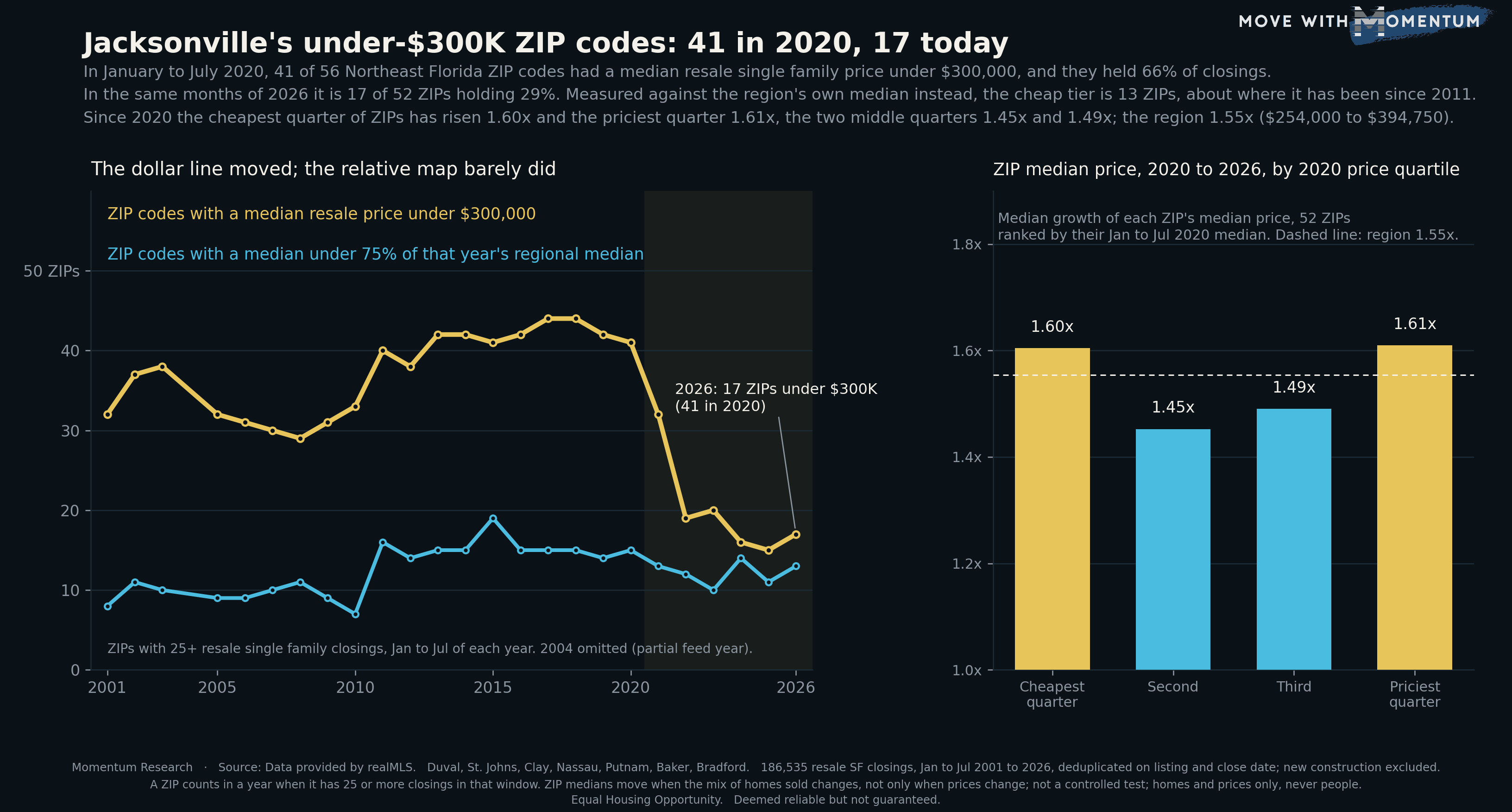
The gold line on the left of the chart is the count of ZIP codes under $300,000. It has been between 29 and 44 for every year from 2001 to 2020, because $300,000 was well above the regional median the whole time (the median was $118,000 in 2001, $207,000 in 2007, $254,000 in 2020). Then the region's median crossed $300,000 in 2021 and the count fell off a cliff: 41, 32, 19, 20, 16, 15, 17. The 2026 read of 17 is two more than 2025, on a regional median of $394,750 that is itself up 4% on the year, so the small uptick is the mix of ZIPs that happened to clear the 25-closing bar this year, not a turn.
The 17 ZIPs under $300,000 in January to July 2026, with their median close prices: 32209 ($101,150), 32254 ($125,700), 32206 ($132,000), 32208 ($140,500), Palatka 32177 ($236,000), 32210 ($237,500), 32220 ($259,000), 32211 ($265,000), 32244 ($270,000), 32234 ($277,500), Starke 32091 ($290,000), 32205 ($290,000), 32219 ($294,000), 32218 ($297,000), 32277 ($298,500), 32221 ($299,900) and 32207 ($299,998). Fifteen are Duval County, one is Putnam, one is Bradford. No St. Johns, Clay or Nassau ZIP is under the line; Keystone Heights 32656 sits at exactly $300,000 and Orange Park 32073 at $305,000. Six of the seventeen are within $10,000 of the line, so next year's count could easily read 11.
The relative map barely moved
A fixed dollar line is a moving target in a market whose median rose 55% in six years. So the cyan line asks a different question: how many ZIP codes have a median under 75% of that year's regional median? That is a count of the cheap tier as the market itself defines it, and it is almost flat. Fifteen ZIPs in 2020, 13 in 2026, and between 10 and 19 in every year since 2011. Those ZIPs held 21.5% of closings in 2020 and 20.7% in 2026; in no year since 2005 have they held less than 17% or more than 32%.
The cheap end of the map, in other words, was not erased. It was repriced along with everything else. The ZIPs of 2020 did not vanish; the count fell by 24 because ZIP medians crossed a dollar line that stayed put while the market moved.
Both ends outran the middle
The right panel follows the same ZIP codes through time. Take the 52 ZIPs that had 25 or more closings in both 2020 and 2026, rank them by their 2020 median, split them into quarters, and take the median growth of each quarter's ZIP medians. The cheapest quarter (2020 medians around $175,000) rose 1.60x. The priciest quarter (around $379,000 in 2020) rose 1.61x. The two middle quarters rose 1.45x and 1.49x. The region as a whole rose 1.55x, from $254,000 to $394,750.
It is a U shape, and it survives a change of base year: on 2019 medians the four quarters read 1.79x, 1.58x, 1.57x and 1.71x against a regional 1.68x. Three of the four cheapest ZIPs of 2020 (32209 at $50,000, 32206 at $64,900 and 32254 at $70,000) roughly doubled by 2026; the fourth, 32208, rose 1.26x. At the other end, Ponte Vedra Beach 32082 went from $696,500 to $1,200,000 (1.72x) and Neptune Beach 32266 from $457,000 to $802,500 (1.76x).
The rivals we tested
The 25-closing threshold. A ZIP with a handful of sales has a noisy median, so a ZIP only counts in a year when it has 25 or more closings in the January to July window. At a 15-closing bar the 2026 count under $300,000 is 20 of 56 ZIPs; at 40 it is 16 of 49. The relative count reads 16 and 12. Same picture at every bar.
Partial year. Every year is measured on January through July, so the seven months of 2026 that exist are compared with the same seven months of each earlier year. 2004 is omitted from the chart because the archive holds only 946 closings for that year, a feed gap rather than a market event.
Low base. 2020 was the last pre-surge year, which could flatter the growth of ZIPs that were unusually cheap that spring. The 2019 base gives the same U shape with higher numbers, so the ends-beat-the-middle finding is not an artifact of the base year.
Mix inside a ZIP. This is the one the data cannot answer. A ZIP median rises when the same homes sell for more, and it also rises when larger or newer homes in that ZIP start selling and smaller ones stop. Nothing here controls for size, age or condition, so "the cheapest ZIPs rose 1.60x" means the median closing in those ZIPs rose 1.60x, not that any particular home did.
New construction. Excluded throughout, so a ZIP that added a large builder community does not read as a price jump.
What the data cannot tell you
This is a count of ZIP codes by the median price of the homes that sold in them. It says nothing about any ZIP code beyond that figure, nothing about who lives anywhere, and nothing about whether any home is a good or bad purchase. A ZIP code median is a coarse instrument: 32218 covers a large area with a wide price range inside it, and a $297,000 median there sits on top of closings from under $150,000 to over $600,000. Use the figures as a map of where the price distribution sits, not as a verdict on any place.
How agents can use this data
Four uses, all about pricing and searching for property, none about anyone's choice of where to live:
- Replace "there is nothing under $300K" with the list. There are 17 ZIP codes where the median closing this year is under that figure and roughly half of the closings in each sit below it. A buyer with that budget has a real search area; it is smaller than it was, and it is mostly Duval.
- Price against the ZIP's own trajectory, not the region's. A 2020 comp in a cheapest-quarter ZIP needs a 1.60x adjustment to read in 2026 dollars; in a middle-quarter ZIP 1.45x. The regional 1.55x is wrong for both.
- Watch the six ZIPs within $10,000 of the line. 32219, 32218, 32277, 32221, 32207 and 32205 all sit between $290,000 and $300,000. A seller there is pricing at a round number the whole market is watching; a buyer there is shopping at the edge of the search band that most under-$300K searches are set to.
- Quote the relative measure when a client asks whether the cheap end is gone. It is not: 13 ZIPs sit under 75% of the regional median, about the same count as any year since 2011. What changed is the dollar figure attached to "cheap."
If you use any of these figures with a client, cite the source and the date: Momentum Research analysis of data provided by realMLS, January to July 2026. Market data moves, and a number without a date attached invites an argument you do not need to have.
What this measurement does not do
This is a count of ZIP codes by median resale single family close price, from MLS-recorded closings only. It is not a controlled test and it does not identify a cause. Related work on the same archive looks at how the share of closings under $300,000 has fallen across the whole region, and at how price per square foot differs by the decade a home was built.
People also ask
Which Jacksonville ZIP codes still have homes under $300,000?
In January to July 2026, 17 Northeast Florida ZIP codes had a median resale single family close price under $300,000: 32209 ($101,150), 32254 ($125,700), 32206 ($132,000), 32208 ($140,500), 32177 Palatka ($236,000), 32210 ($237,500), 32220 ($259,000), 32211 ($265,000), 32244 ($270,000), 32234 ($277,500), 32091 Starke ($290,000), 32205 ($290,000), 32219 ($294,000), 32218 ($297,000), 32277 ($298,500), 32221 ($299,900) and 32207 ($299,998). Fifteen are in Duval County. Keystone Heights 32656 sits at exactly $300,000 and Orange Park 32073 at $305,000. These are medians, so about half the closings in each ZIP were above the figure and half below.
How many Jacksonville ZIP codes were under $300,000 before the pandemic?
In January to July 2019, 42 of the 54 ZIP codes with 25 or more resale closings had a median under $300,000, and in 2020 it was 41 of 56. Those ZIPs held 75% of the region's resale single family closings in 2019 and 66% in 2020. The count fell to 32 in 2021, 19 in 2022, 20 in 2023, 16 in 2024, 15 in 2025 and 17 in 2026, when the under-$300,000 ZIPs held 29% of closings. Under $250,000, the count went from 34 ZIP codes in 2020 to 6 in 2026.
Did cheaper Jacksonville ZIP codes appreciate less than expensive ones?
No. Ranking the 52 ZIP codes present in both 2020 and 2026 by their 2020 median and following each one forward, the cheapest quarter of ZIPs rose a median 1.60x and the most expensive quarter 1.61x, while the two middle quarters rose 1.45x and 1.49x. The regional median rose 1.55x, from $254,000 to $394,750. Three of the four cheapest 2020 ZIPs (32209, 32206 and 32254, all under $71,000 then) roughly doubled. The same U shape appears on a 2019 base: 1.79x, 1.58x, 1.57x and 1.71x.
Method and limits
Source: data provided by realMLS. Closed resale single family sales in the authoritative counties of Duval, St. Johns, Clay, Nassau, Putnam, Baker and Bradford. Records are deduplicated on listing id plus close date. Closings under $10,000, listings flagged NewConstructionYN and records without a five-digit postal code are excluded. 186,535 closings remain across the fixed January to July window, 2001 through 2026; 9,960 of them in 2026.
A ZIP code counts in a year when it has 25 or more closings in that window; its figure is the median close price of those closings. The regional median is the median of all closings in the window, not the median of the ZIP medians. The relative tier is every counted ZIP whose median is under 75% of the regional median for that year. Growth by quartile ranks the 52 ZIPs counted in both 2020 and 2026 by their 2020 median, splits them into four groups of 13, and takes the median of each group's 2026 to 2020 ratio; the 2019 check does the same on the 51 ZIPs counted in both 2019 and 2026. 2004 is omitted from the chart (946 closings in the archive for that year).
Nothing is controlled for size, age, condition, lot or financing, and a ZIP median moves with the mix of homes sold as well as with prices. Cause is not identified. ZIP codes are described by their price figures only.
Related reading on the same archive: how days on market now compare between the priciest and cheapest tiers and the ongoing Jacksonville housing market tracker.
All figures on this page are per Momentum Research analysis of data provided by realMLS and are deemed reliable but not guaranteed. Equal Housing Opportunity.